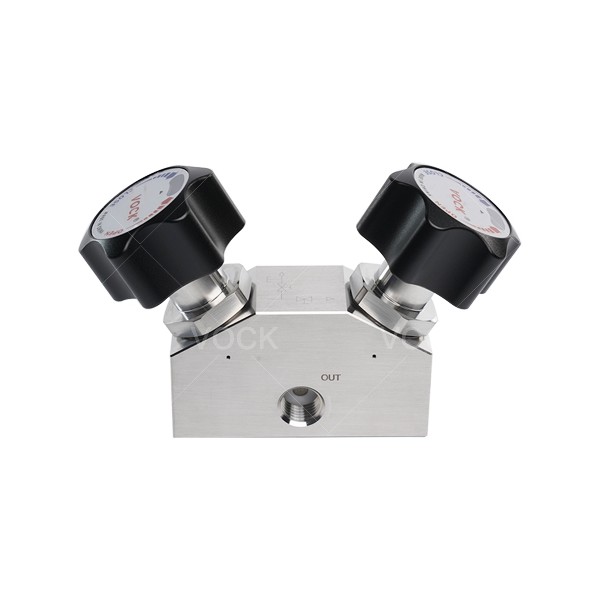
Three-Way Diaphragm Valves
A three-way diaphragm valve replaces two or three separate shut-off valves where a gas line must be switched between process, purge and vent. Fewer bodies mean fewer welded joints, less dead volume and a simpler leak-check scope.
Valonix three-port valves are used in cylinder changeover panels, purge sequencing on VMB/VMP systems and diverting lines on MOCVD tools. They are available in manual and pneumatic versions with VCR face seal or butt-weld ends.
Switching topology
The common port is normally connected to the process source, with the two outlet ports assigned to process delivery and purge/vent. Confirm the flow path orientation on the datasheet: a three-way valve is not a mixing valve, and the direction of flow affects seat loading.
- One common port plus two switched ports
- Process/purge or process/vent routing
- Specify flow direction at ordering stage
Purge sequence and cross-contamination
Switching between incompatible gases is the highest-risk operation in a specialty gas system. The valve must fully isolate the process port before the purge port opens. Pneumatic versions with position feedback make it easier to prove the sequence to a tool controller.
- Break-before-make switching behaviour
- Position feedback for interlock proof
- Low internal volume reduces purge time
Sizing and pressure
Three-way diaphragm valves are commonly supplied in 1/4, 3/8 and 1/2 in ports with a Cv around 0.3 and a working pressure of 145-300 PSI. Pneumatic switching versions need a 70-125 PSI actuator supply, higher than a standard two-way valve.
- 1/4, 3/8 and 1/2 in VCR ports
- Cv approx. 0.3
- 145-300 PSI working pressure
Valves in this category
Typical specifications
| Ports | 3-port, 1 common + 2 switched |
|---|---|
| Port sizes | 1/4", 3/8", 1/2" |
| Cv | 0.3 |
| Working pressure | 145-300 PSI |
| Actuator supply | 70-125 PSI pneumatic |
| End connections | VCR face seal, butt weld |
Frequently Asked Questions
Can a three-way diaphragm valve mix two gases?
No. It is a diverting/switching valve. Mixing requires a dedicated mixer with controlled flow paths.
Why is the actuator pressure higher than a standard pneumatic valve?
The switching mechanism moves between two seats and needs additional thrust, hence the 70-125 PSI supply.
Does a three-way valve reduce leak points?
Yes. Replacing two valves and their connecting tee with one body removes several welded or face-seal joints from the leak-check scope.