Bellows Sealed Valves
When a specialty gas is toxic, pyrophoric or highly corrosive, the stem seal becomes the critical leakage path. A bellows sealed valve replaces conventional packing with a welded metal bellows, creating a hermetic barrier between the process gas and the atmosphere.
Valonix bellows valves are specified for halide and hydride service, high temperature lines and any installation where a measurable zero-emission stem seal is required by the site safety case.
How a metal bellows seal works
The stem moves axially while the welded bellows flexes, so no sliding seal is exposed to the gas. The bellows assembly is helium leak tested both statically and through the full stroke. A secondary packing above the bellows is common as a backup, but it is not part of the primary containment boundary.
- Hermetic welded metal bellows on the stem
- No elastomer packing in the gas path
- Helium leak tested through full stroke
Bellows versus diaphragm valves
A diaphragm valve uses a flexible diaphragm as both the closing element and the stem barrier, with a short flow path and low dead volume. A bellows valve uses a rigid plug or disc with a bellows on the stem, and generally tolerates higher temperature and more aggressive media. For the highest purity at moderate temperature, choose a diaphragm valve; for aggressive or hot toxic gas, choose bellows.
- Diaphragm: lowest dead volume, best for UHP distribution
- Bellows: better for hot, toxic or aggressive media
- Both are helium leak tested
Material compatibility
Chlorine, hydrogen chloride, ammonia and silane each impose different material constraints. State the full gas list, concentration, temperature and whether the line sees vacuum, so the wetted alloy and bellows material can be selected rather than assumed.
- 316L or nickel alloy wetted parts
- Bellows material matched to gas chemistry
- Vacuum and thermal cycling data on request
Valves in this category
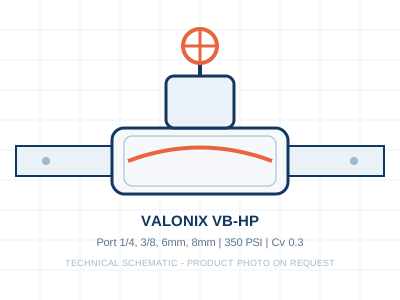 VB-HP
VB-HP Bellows Sealed Valve
- Port size1/4, 3/8, 6mm, 8mm
- Max. pressure350 PSI
- Cv0.3
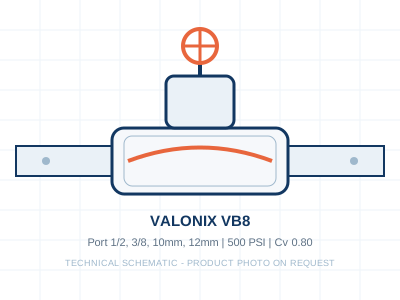 VB8
VB8 Low Pressure Bellows Sealed Valve
- Port size1/2, 3/8, 10mm, 12mm
- Max. pressure500 PSI
- Cv0.80
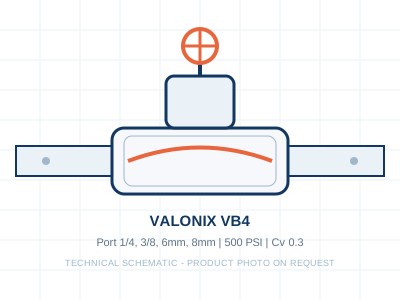 VB4
VB4 Low Pressure Bellows Sealed Valve
- Port size1/4, 3/8, 6mm, 8mm
- Max. pressure500 PSI
- Cv0.3
Typical specifications
| Seal type | Welded metal bellows, hermetic |
|---|---|
| Port sizes | 1/4", 3/8", 1/2", 6-12 mm |
| Working pressure | 350-500 PSI |
| Cv | 0.3-0.8 |
| End connections | VCR, butt weld, compression |
| Actuation | Manual or pneumatic |
Frequently Asked Questions
When should I use a bellows valve instead of a diaphragm valve?
Use bellows sealed valves for toxic, corrosive or high temperature services where a hermetic stem seal is mandated; use diaphragm valves for the cleanest UHP distribution lines.
Is the bellows leak tested?
Yes, the bellows assembly is helium leak tested both statically and across the full stroke.
Can bellows valves handle vacuum purge?
Yes. They are commonly used on lines that cycle between vacuum and positive pressure; confirm the cycle count at specification stage.